
Made With Europe?
Kinda


Last week the European Commission [finally] published its proposed Industrial Accelerator Act (IAA).
Among other things, it attempts to push manufacturing’s share of EU GDP to 20% by 2035 through subsidies, procurement rules, and a fairly explicit “Buy European” push.
The interesting question is what this means for companies producing outside the EU — including in the EU’s closest trade partners.
This is where things get complicated.
On the surface, Articles 8 [public procurement] and 9 [other forms of public intervention] allow for content originating in third countries with which the Union has concluded an agreement establishing a free trade area or a customs union, or [in the case of Article 8] that are parties to the Agreement on Government Procurement, where relevant obligations of the Union exist under that agreement, shall be deemed to be of Union origin.
So far so good (unless you’re from a country that doesn't meet those criteria).
Buuuuut there are of course some additional conditions.
These allow the Commission to exclude countries if, for example [my favourite in bold]:
(a) that third country has failed to provide national treatment related to Union products or entities under the agreements referred to in paragraph 1 in relation to any of the sectors listed in Annex I;
(b) such exclusion is justified to avoid dependencies or any other developments that may threaten the security of supply in the Union of the products in question;
(c) such exclusion is justified under any other exception under the applicable agreement.
Also, as I pointed out on LinkedIn last week, in the case of autos, it is not at all clear to me that any equivalence provisions would extend to final assembly in a partner country. Or to put it another way, as written, it appears that the EU would be okay with parts being sourced from trusted partners, but not the final vehicle.
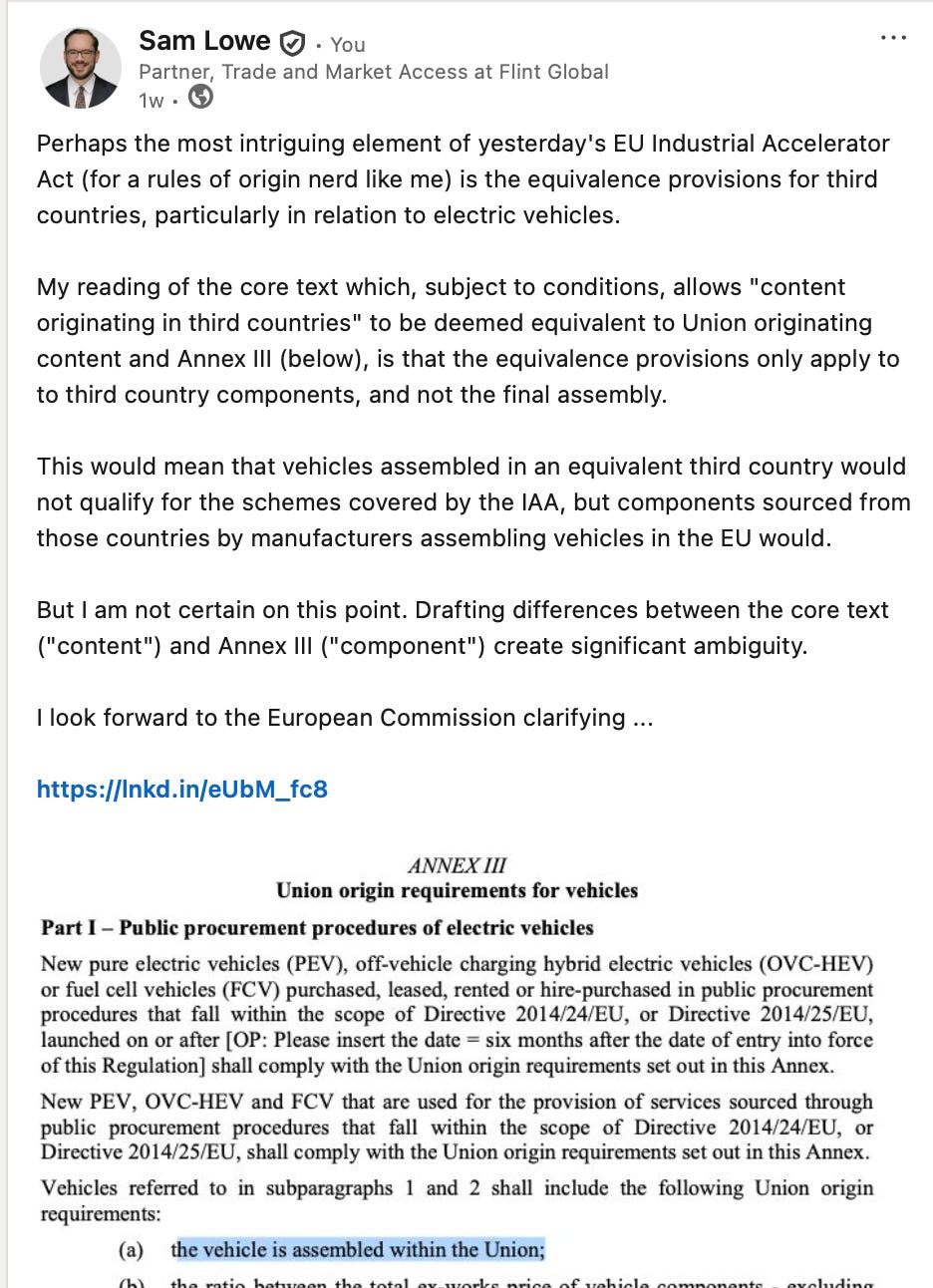
My current assumption — particularly given how often the Commission has now been asked about this — is that this was indeed DG GROW’s intention, but that it may not have been fully cleared across the rest of the Commission.
Now they are working out whether to stick or twist.
So TBC.
To illustrate how messy this could become in practice, it’s worth walking through what an OEM would actually need to do to ensure an EV qualifies for support under the IAA.
Key criteria:
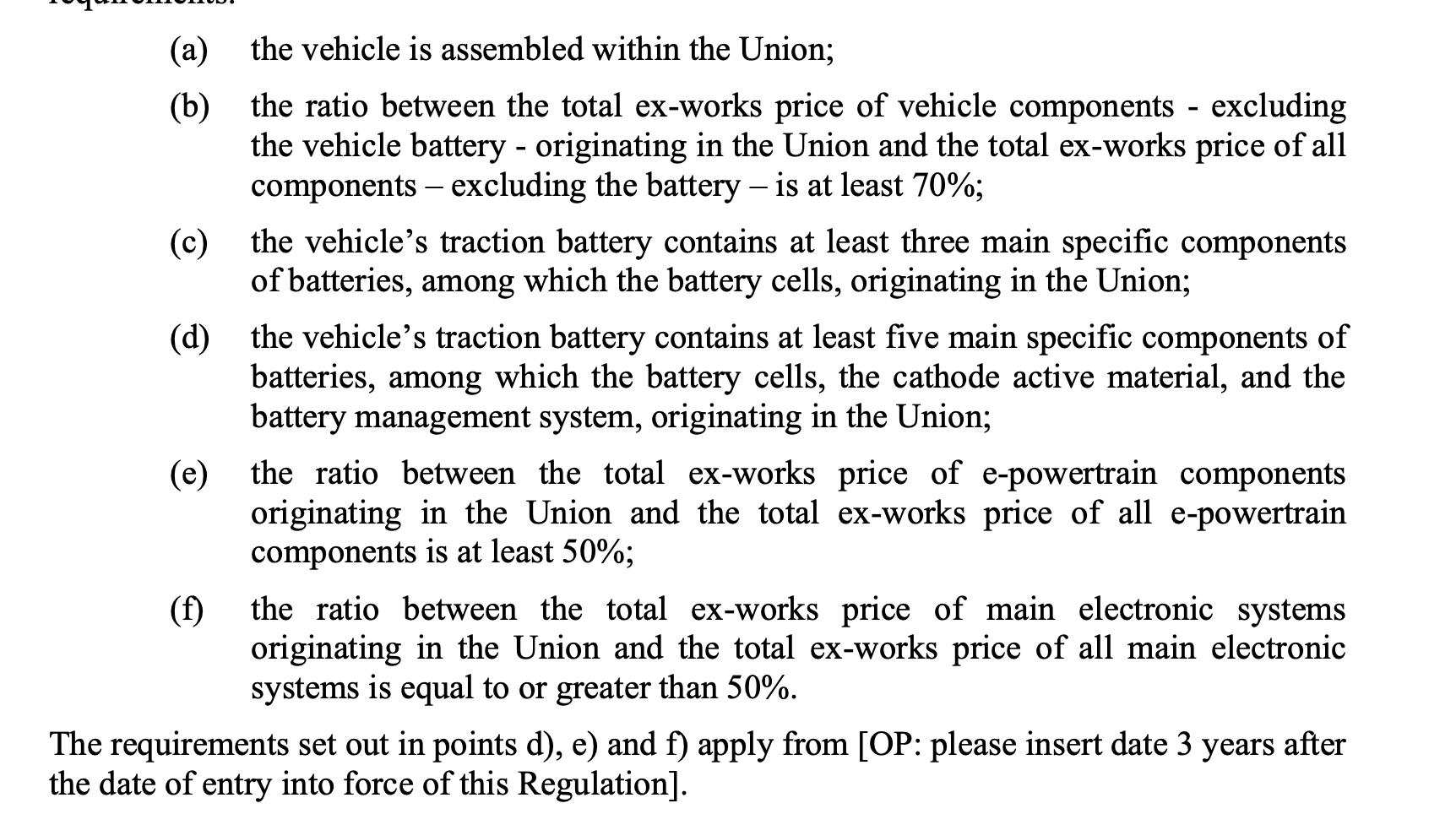
For the purposes of keeping this spicy, let’s assume a five-year lead time on the EV (meaning that points d), e) and f) apply).
Let’s also assume that, to avoid the issue raised earlier, the EV is assembled in the EU.
Option A: Source everything from within the EU
Here the main issue is that you have to cross your fingers and pray that enough cathode active material is produced in the EU by then, which it currently very much isn’t. You also have to go through a bit of admin to demonstrate the stuff from the EU is actually from the EU, which requires complying with EU non-preferential rules of origin … which are supposedly going to change at some point … but y’know, it’s workable, if quite expensive.
Option B: Source 50% of the inputs from FTA partners
For the FTA (or customs union) partner inputs, you have to plan your sourcing based not only on the basis of there being an FTA, but also on the assumption that the countries included will not fail to provide reciprocal treatment to EU products, create dependencies or threaten the security of supply, or “other reasons”.
Basically you need to be fairly confident they are not going to piss off the Commission in the period it takes to get production off the ground.
In other words, access to EU industrial support will depend not just on supply chains or free trade agreements, but also on the Commission’s evolving view of which partners are sufficiently “reliable”.
Which introduces a fairly significant geopolitical variable into long-term manufacturing decisions.
So Norway? Probably fine. Japan? Yeah … okay then. The UK? Ummm. Turkey? Ummmmmmmm.
Anyway, once you’ve decided you’re going to go with, say, South Korea, Japan, and Morocco, you then need to make sure the inputs actually originate from those countries. And given that the condition of equivalence is dependent on the existence of a free trade agreement, surely you can just rely on the free trade agreement’s rule of origin. Well, no. You actually have to rely on the non-preferential rules of origin which, as above, may change.
More of an issue is the value thresholds themselves. This is because prices change! All the time.
So let’s take b) and the requirement for 70% of the factory door value of the vehicle, excluding the battery, to originate in the EU or partner countries. In practice, you’re going to need to give yourself some leeway. So probably, you’re going to have to aim for around 80%, just incase the price of the non-originating inputs goes up, or the originating inputs goes down.
Anyway, I suspect we’ll be coming back to the IAA repeatedly over the coming months — if only because the proposal is likely to be subject to years of negotiation, edits, and interpretive disputes.
Section 301
As expected — see my piece “The Supreme Court Ruling Was Bad For Business” — the Section 301 era has begun with a bang.
Today, the US opened a Section 301 investigation against China, the European Union, Singapore, Switzerland, Norway, Indonesia, Malaysia, Cambodia, Thailand, Korea, Vietnam, Taiwan, Bangladesh, Mexico, Japan, and India claiming that they are damaging American competitiveness by producing more goods than they can consume domestically.
Read the Federal Register notice HERE and the Hinrich Foundation’s Debbie Elms’s explainer HERE.
And this is just the beginning. Greer also said in a press conference that further Section 301 investigations would be launched, including into forced labour practices (supposedly covering 60 countries, potentially as early as today), digital service taxes, and pharmaceutical and medicinal pricing mechanisms.
But what else could be targeted?
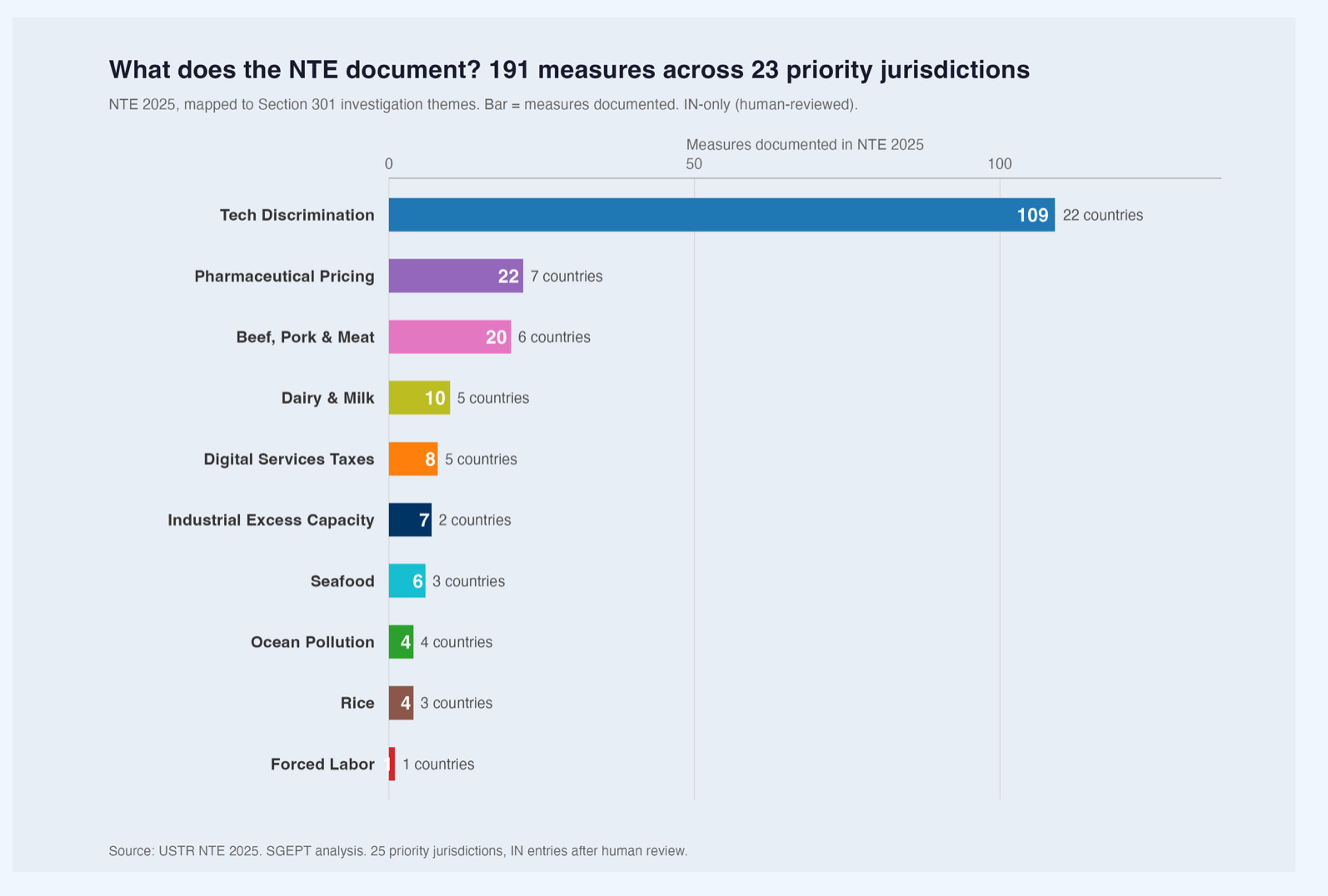
Johannes Fritz and his team at Global Trade Alert have done the Lord’s work and trawled through the US’s National Trade Estimate report to pull out some possibilities.
Read it HERE.
Also, this chart:
The rest of this edition is for paid subscribers.
Below: a chart on Chinese tech investment in Europe, an argument that Trump’s tariffs may be forcing reform in China, and a paper that complicates the idea that tariffs are fully passed through to consumers.
