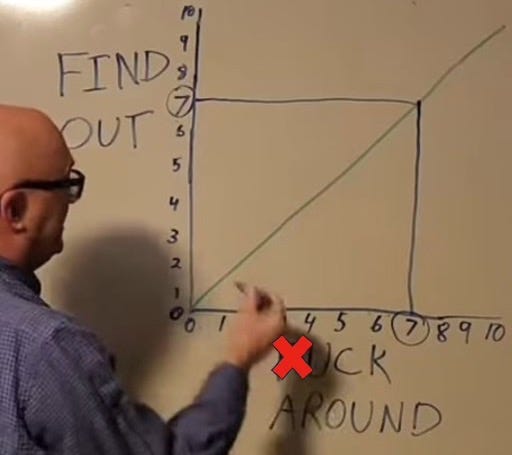
I am going to assume you all know what FAFO stands for. In case not, the polite version is “Mess Around; Find Out”.
I have two FAFO theories of trade: The FAFO of trade policy and the FAFO theory of trade negotiations.
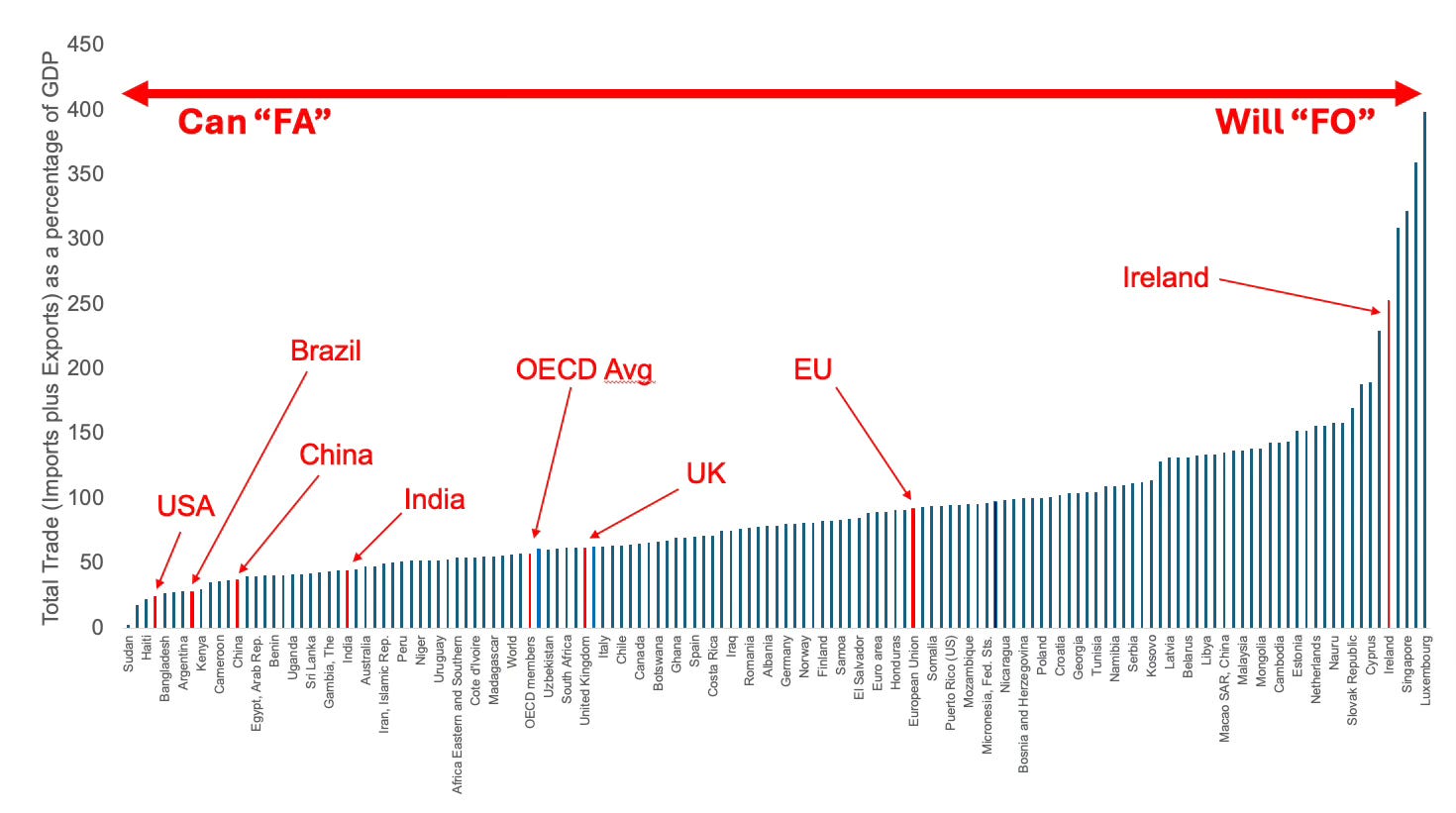
The FAFO theory of trade policy is that the degree to which countries [or blocs] can do stupid things with their trade policy before finding out [i.e. things going wrong] is negatively correlated with their overall economic reliance on trade.
An economy with a relatively low reliance on trade can afford to FA for quite a long time without FO. An economy with a high reliance on trade really shouldn’t FA because they will FO pretty quickly.
In chart form:
Chart 1: Who can FA and who will FO?
Source: MFN analysis, World Bank, 2024
This theory does, in part, explain why the US can and has, even pre-Trump, been able to FO quite a lot. It also explains, conversely, why the EU is less able to do so, even accounting for the fact that the EU’s high figures is in part explained by internal trade. It also, in part, explains why countries such as Brazil and India are more able to stand up for themselves than others.
Trump is of course, now pushing the US tolerance to the max, and we have seen some retreats from the most extreme tariff threats (e.g. 145% on China), but it’s also why I’ve consistently argued that a) Trump will impose new tariffs and they will probably be quite sticky, and b) I’m more worried about their impact on other countries than on the US.
This brings me to the FAFO theory of trade negotiations. Or rather, the FAFO theory of [Trump’s] trade negotiations.
When you make lots of threats, the worst thing you can do is fail to follow through on any of them. But ideally, you don’t want to follow through on all of them. So what you want to do is make an example of someone who is not playing ball. Ideally, you make an example of someone who is well known enough to catch everyone’s attention, but with limited means to punch back.
This dynamic is important when considering one of the big question marks coming out of the more recent flurry of Trump tariff announcements: Why is Trump being so mean to Switzerland?
Switzerland … didn’t really do anything wrong. It already zero rates industrial tariffs and is never going to be a big buyer of American food given it doesn’t have many people. Sure, it exports a lot of pharma [and gold] to the US, but the reciprocal tariffs don’t cover that anyway. But maybe it didn’t offer Trump a big enough bribe investment commitment upfront. Maybe they kinda did a bit of FA.
So anyway, now they have FO (at very little cost to the US and US consumer, unless you are big into luxury watches and chocolate) and serve as a cautionary tale to everyone else still negotiating with the US.
And to be honest, it could have happened to anyone. But unfortunately for the Swiss, it happened to them.
Obviously there is a more extreme version of this. See, for example, the escalating trade tensions between the US and India, and the US and Brazil. This dynamic is slightly more interesting, because, referring back to the FAFO theory of trade policy, both India and Brazil can afford FA a bit, if not to the same extent as the US.
In this case, it is more of a game of chicken. Who is going to blink first?
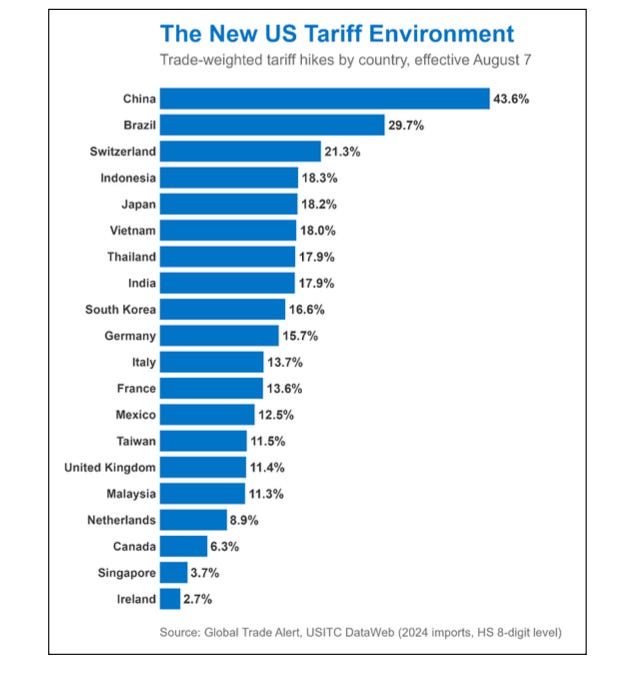
Chart of the week
The good folk at Global Trade Alert are continuing to do the Lord’s work by producing all of the Trump-related charts you could ever need.
Even if countries do follow the EU in negotiating lower headline rates, we expect average applied rates to be higher. This is because of the US’s focus on supply chain security, which has been embedded as a condition in several agreements, including those with the UK and Japan. The UK deal says that preferential treatment on pharmaceuticals will be contingent on the UK meeting “US requirements on the security of supply chains”. “Security of supply chains” is widely understood to be a euphemism for China exposure.
In practice, there is a high likelihood that the US will apply strict rules of origin criteria to any pharmaceutical imports, with an emphasis on the origin of the Active Pharmaceutical Ingredients (APIs) based on past US customs rulings. As per the recent Executive Order on reciprocal tariffs, goods deemed to have been “transhipped” to avoid the US’s new country-specific rates are subject to an additional tariff rate of at least 40%. While the US reciprocal tariffs and subsequent transhipment penalties do not apply to pharmaceutical products, similar provisions could be introduced as part of any Section 232 tariffs.
As an illustrative example, 2021 ECIPE research estimates that China supplies 22.6% of the EU’s APIs by volume, while India provides 3.1%. Depending on the exact product export profile, this means that even in a deal scenario, around a quarter of EU pharmaceutical exports to the US could be subject to a higher duty rate due to those exports no longer being deemed to have EU origin by US customs.
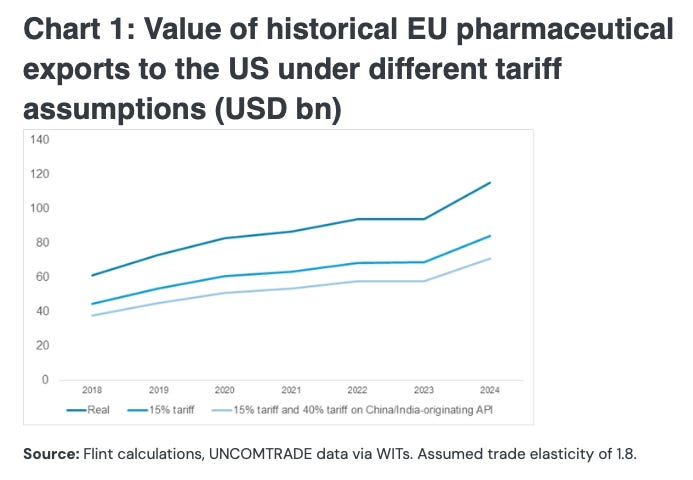
Such an outcome would have a significant impact on the value of any US deal for pharmaceutical exports. Chart 1 shows the estimated historic value of EU pharmaceutical exports to the US from 2018 to 2024, assuming a 15% US tariff was applied to all imports, and separately assuming the application of a 15% tariff plus strict country of origin enforcement and a 40% tariff on the proportion deemed to use China/India-originating APIs.
With UK's inaction currently contributing to it's demise, you could equally say DFAFO – don't fuck around and find out.
Conversely, Ireland's success is largely the result of fucking around and a huge dollop of serendipity. As someone who lives in Dublin, woohoo!
China? If they didn't fuck around they would either have remained communist, or, a la Russia, would have suffered shock therapy administered to them by the likes of Sachs.
First best world and second best world economics both assume markets are super information processors, so dicking around always ends badly. As the above illustrates this is patently not true. But saying FASPOASD – f'n about sometimes pays off and sometimes doesn't, isn't exactly pithy.
Great stuff Sam. A must-follow for anyone interested in trade and international business. Ireland's position on the FAFO chart and the importance of big pharma in it's economy brings to mind a certain recurrent Star Wars line.


With UK's inaction currently contributing to it's demise, you could equally say DFAFO – don't fuck around and find out.
Conversely, Ireland's success is largely the result of fucking around and a huge dollop of serendipity. As someone who lives in Dublin, woohoo!
China? If they didn't fuck around they would either have remained communist, or, a la Russia, would have suffered shock therapy administered to them by the likes of Sachs.
First best world and second best world economics both assume markets are super information processors, so dicking around always ends badly. As the above illustrates this is patently not true. But saying FASPOASD – f'n about sometimes pays off and sometimes doesn't, isn't exactly pithy.
Great stuff Sam. A must-follow for anyone interested in trade and international business. Ireland's position on the FAFO chart and the importance of big pharma in it's economy brings to mind a certain recurrent Star Wars line.