
How to do more tariffs
"Don't go giving him any ideas"


The lawyers have been having the time of their lives this week as the US Supreme Court began considering the legality of Trump’s IEEPA tariffs.
In the grand scheme of things, over, say, a 6-month time horizon, this court case probably doesn’t matter very much at all. Win or lose, there are still gonna be loads of tariffs.
But as of now, it creates significant uncertainty, both about the court’s decision itself and, if the tariffs are found to be illegal, how Trump might replace them, which products might fall through the gaps, etc.
I’ve discussed before the various options for different legal instruments, and pretty much everyone else has, too.
Yeah, we’re talking about a bit of Section 122 of the 1974 Trade Act, followed by a lot of Section 338 of the 1930 Tariff Act, Section 232 of the 1962 Expansion Act, and Section 301 of the 1974 Trade Act.
The best discussion was on the FT podcast, between Alan Beattie and Jennifer Hillman. [Transcript HERE.]
But, y’know, there is another way to ensure the tariff burden remains high on lots of, if not all, products. And it doesn’t require any new investigations.
What am I talking about? Derivative tariffs, of course.
To recap:
As part of his innovative new trade policy, the US President has, in some instances, applied Section 232 tariffs (i.e. national security tariffs) not only to the product under investigation but also to downstream derivative products.
This means that you get incidents such as this:
… let’s imagine I import canned beer from Belgium into the US. What’s the tariff on canned beer from Belgium?
Well, first I need to check what the pre-Trump MFN tariff rate is. Turns out it is 0 per cent. I then need to check the country-specific rate, which is currently 10 per cent for the EU/Belgium, but could rise to 30 per cent on 1 August, as per Trump’s threats. So far, so good.
However, canned beer is shipped in a … can. And beer cans are usually (always?) made of aluminium. And, as of 4 April, beer cans were added to the list of aluminium derivative products subject to specific tariffs. This means that the aluminium content of the beer is subject to an additional tariff, typically 50 per cent.
At the moment, these derivative tariffs only apply to a subset of products linked to the Section 232 tariffs on steel, aluminium, copper and lumber.
But these lists keep on growing.
Over the summer, exporters of excavators (for the Brits: yellow diggers) suddenly found their product had been added to the steel derivative list. This means that the excavators exported to the US suddenly faced a 25% tariff on the value of its steel content if from the UK, and a 50% tariff on the value of its steel content if from anywhere else.
So … what if you just added everything to the derivative lists?
And what if you were to bring into effect all the live Section 232 investigations, and in particular the ones I’ve put in red boxes, and apply the duties to all their derivative products too?
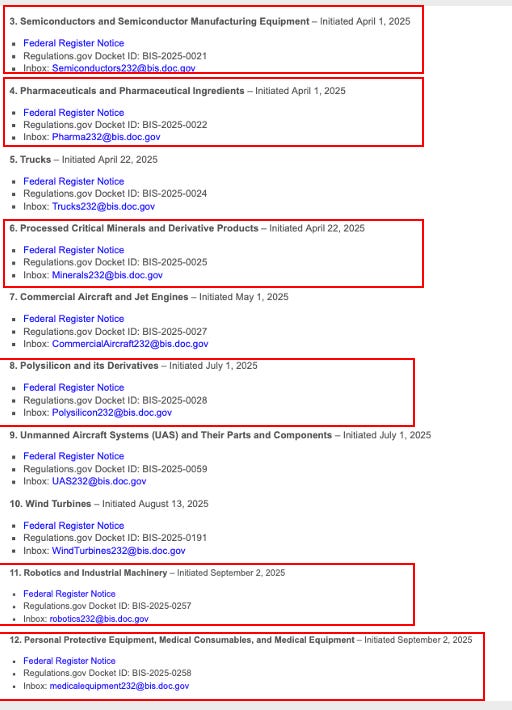
I’m not saying that it would result in the same tariff levels currently imposed under IEEPA, but it would mean that a lot of imports still get hit by tariffs.
Anyway, if this happens, I did warn you, and it’s not my fault.
Chat sh*t, get banged
Given all of the drama in Washington DC, you would be forgiven for having missed that the chair of the European Parliament’s Committee on International Trade published his draft reports on the EU’s implementing measures relating to its trade deal with the US.
For those of you who have not been following this, a reminder: The EU-US trade deal is not technically a trade deal, and therefore, rather than a normal treaty ratification process, the EU instead has to pass new legislation bringing into force the tariff commitments it has made to the US. This means that, rather than the usual Yes/No vote, the European Parliament can propose amendments to the regulation that the US definitely will not like, and the European Commission will ultimately be unable to accept them because they are not included in the actual agreement with the US.
So what we have, in practice, is hours of fun.
Because, obviously, these draft reports propose some changes.
These include:
The introduction of an 18-month sunset clause to ensure the preferential tariff treatment is only temporary
New safeguards to allow the EU to suspend preferential tariff and quota treatment if there is a surge in US imports
New conditions on steel and aluminium
However, my main concern while this plays out is that
a) It is going to take ages and at some point the US will notice it is taking ages and therefore threaten to re-impose higher tariffs on e.g. EU car exports unless they hurry up
b) Someone shows Trump a screenshot or video of some random MEP being mean about him and/or trying to get the deal changed and he retaliates by cancelling the deal because he thinks a random MEP is speaking for the entire EU. I like to call this “Doing a Doug Ford”.
Anyway, let’s hope the President’s attention remains elsewhere.
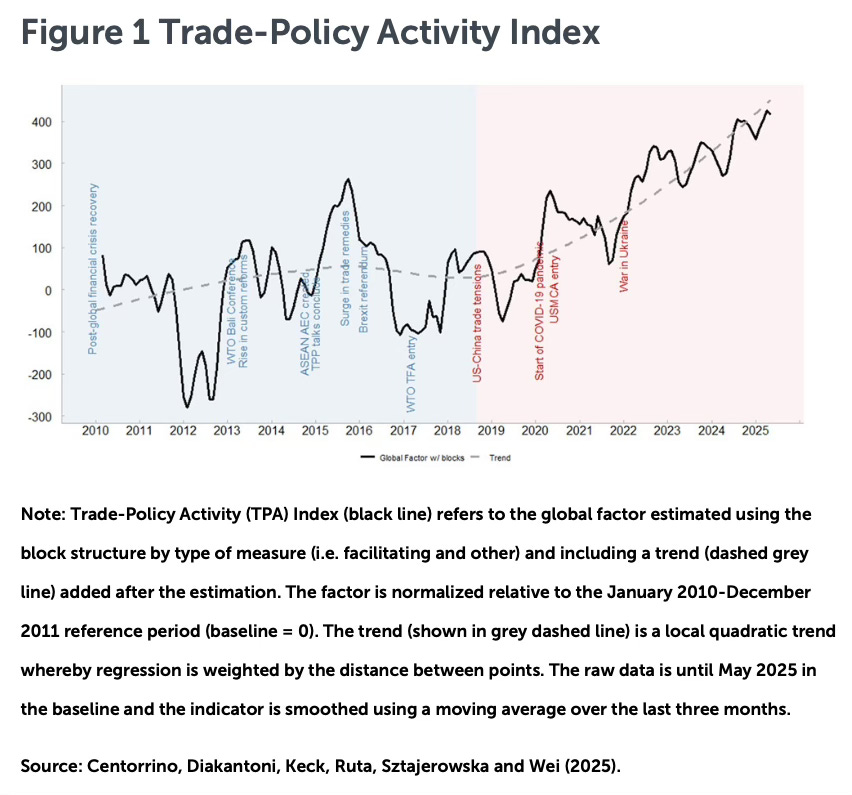
Chart of the week
From the IMF/WTO:
Further Reading
DG Trade’s Lucian Cernat has published a new paper presenting three possible scenarios for future trade policy: Immunity, Sclerosis, and Contagion. I’m probably team Sclerosis, but I worry a lot about Contagion. Read it HERE.
Best,
Sam